
About Us
Australia’s Defence Industry
Australia’s defence industry supports the advanced needs of the Australian Defence Force (ADF) that deploys globally. This includes operations and exercises with close partners such as the United States of America (US), India, Japan and the United Kingdom (UK); and to regions as diverse as the Indo-Pacific, Africa and the wider Middle East. The technologies the ADF uses are battle-proven and meet the highest standards of safety and survivability.
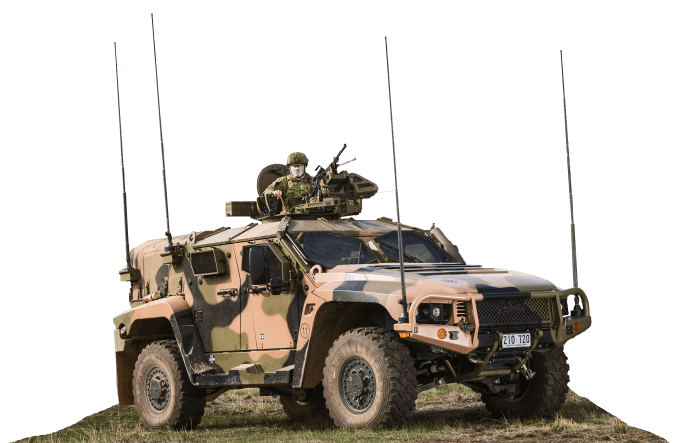
Australia’s defence industry has delivered modern warships and submarines, land vehicles and weapon systems, and supported highly advanced aerospace systems. Additionally, Australia has a global reputation for innovation in areas such as cyber, hypersonics, quantum and autonomous systems. Australia exports these advanced capabilities to a range of militaries globally.
Australia’s defence spending has greatly increased in response to the findings and recommendations outlined in the 2023 Defence Strategic Review and the subsequent 2024 National Defence Strategy (NDS). These initiatives are intended to modernise the ADF and ensure it is well-positioned to address long-term security needs.
The Australian government has allocated A$330 billion to Defence through the next decade to 2033-34, representing a restructured approach to Defence’s capability procurement. It includes an additional A$50.3 billion over the next decade specifically to deliver the following capabilities:
- A Navy with enhanced surface fleet lethality and conventionally armed, nuclear-powered submarines through the AUKUS Partnership to improve Australia’s deterrence capabilities;
- An Air Force capable of delivering long-range intelligence, surveillance, reconnaissance (ISR), and improved strike capabilities across maritime, land, and air domains;
- An Army prepared for littoral manoeuvre, equipped with long-range strike capabilities for land and maritime operations;
- Modern guided weapons across the force, including; Tomahawk, SM6, Naval Strike Missile, LRASM & JASSM-ER;
- Strengthened and integrated space and cyber capabilities, including cyber warfare, electronic warfare, and space-based situational awareness.
Additionally, Australia is investing more than A$3.4 billion over the next decade to enable Australian companies to develop their defence technologies with the establishment of the Advanced Strategic Capabilities Accelerator (ASCA). This investment and strategic planning will accelerate the development of capabilities identified as critical for the ADF and its partners, ensuring the industry can meet emerging defence needs. Simultaneously, industry will also continue to develop new capabilities that can be provided to global partners.
Maritime Systems
Australian industry develops sophisticated naval and surveillance sensors for use by the ADF, which is currently upgrading its naval capabilities. Naval shipbuilding, sustainment and upgrade activities are one of the seven Australian Government priorities identified in the 2024 Defence Industry Development Strategy. Australia’s acquisition of at least eight nuclear-powered submarines, the first initiative under AUKUS, will further expand Australia’s sophisticated naval capabilities. Complementary to this initiative, Australia is focused on accelerating Guided Weapons and Explosive Ordnance capability, and investing in Australia’s shipyard infrastructure.
In line with the recommendations of the 2024 Independent Analysis of the Surface Combatant Fleet, the Australian Government is currently upgrading and expanding the fleet to 26 new major surface combatants with a significant investment of A$54.2 billion for acquisition and sustainment of the fleet over the next decade. Australian industry possesses proven capabilities across the maritime shipbuilding, sustainment and upgrade domains, particularly in new and novel sensors already deployed on Royal Australian Navy (RAN) platforms. Australia’s modernised fleet will consist of:
- 26 major surface combatants:
- Three Hobart class Air Warfare destroyers with upgraded air defence and strike capabilities;
- Six Hunter class (BAE System’s modified Type 26) frigates to boost Navy’s undersea warfare and strike capabilities;
- 11 new General Purpose Frigates that will provide maritime and land strike, air defence and escort capabilities; and
- Six new Large Optionally Crewed Surface Vessels (LOSVs) that will significantly increase Navy’s long-range strike capacity.
- 25 minor war vessels to contribute to civil maritime security operations, which includes six Offshore Patrol Vessels (OPVs); and
- At least three Virginia class SSNs from the US, with the option for two more, while in the long run, developing an AUKUS-SSN design jointly with the UK, which is expected in the 2040s.
The RAN and Australian industry are also developing novel technologies in unmanned underwater vessels (UUV), unmanned surface vessels (USV) and enabling technologies. Several Australian companies are developing UUV and USV with capabilities to assist with persistent surveillance, detection, electronic warfare, mine-hunting, and kinetic response. These include Anduril’s extra-large uncrewed submarine Ghost Shark, C2 Robotics’ Speartooth and the Bluebottle USV from Ocius Technology.
Air & Autonomous Systems
The Royal Australian Air Force operates cutting edge air combat platforms and surveillance aircraft, including F-35, P-8, E-7A, and EA-18G. Australia has over 50 companies playing integral roles in the build and sustainment of the F-35 Joint Strike Fighter Program. Australian companies are supplying critical components on the program worth over A$2 billion, which includes weapon adaptors, advanced composites and precision machined parts. Adoption of Unmanned Aerial Systems (UAS) technology across government agencies, plus adoption in major Australian industries such as mining and farming has supported the emergence of a world-leading UAS industry within Australia. Australia has invested in the future development of the industry, establishing the Trusted Autonomous Systems Defence Cooperative Research Centre.
Australia’s ASCA is also investing in the next stage of UAS development with the Sovereign UAS Challenge finalised in April 2024, resulting in three Australian companies signing contracts for a total of A$6.6 million to finalise development and produce 100 general purpose UAS.
Australia has decades of experience in researching, designing and manufacturing complex composite aerostructures both for sovereign aircraft and UAS designs. The need to cover long distances in Australia has seen accelerated development in hybrid power solutions and alternate power supply solutions. Our large land mass also means UAS manufacturers in Australia have ready access to aviation testing ranges. Counter-autonomous and Counter-UAS systems are also rapidly becoming a key capability for acquisition with the proliferation of cost effective, expendable and high mobility unmanned aerial systems, most recently with the ongoing conflict in Ukraine and the Red Sea crisis. Australian industry is also driving the development and manufacturing of hypersonic engines and systems. Leading Australian hypersonic innovators are working closely with allied partners to test and develop robust technologies, while Australia’s leading research and development institutions and universities are supporting workable breakthroughs in the field.
Maintenance Repair & Overhaul & Additive Manufacturing
In a very competitive global market, Australia has many of the prerequisites required to play a significant Maintenance Repair and Overhall (MRO) role across the Indo Pacific region, meeting our own domestic needs and those of our allies. Australian industry has a strong foundation based on innovative technologies and a proven ability in complex systems and services delivery, including a range of MRO capabilities for various types of aircraft, ships and vehicles, including many that are common to the US military. The Regional Sustainment Framework is a US defense strategy aimed at optimising MRO capabilities across the Indo-Pacific region by leveraging allied partners like Australia, essentially creating a distributed network where countries can sustain each other’s military equipment locally, rather than relying solely on US bases. Australia is actively collaborating with the US to implement this framework, particularly by identifying opportunities for joint MRO activities within its territory.
The Australian aerospace MRO industry consists of several large primes and many small and medium enterprises with specialised niche capabilities and extensive experience across major commercial and military platforms including but not limited to F-35, F/A-18, P8 Poseidon, and Boeing and Airbus commercial aircraft. Australia’s MRO capabilities broadly support: Platform & Vehicle Systems; Propulsion Systems; Mission & Electronic Systems; Autonomic Logistics; and Aircraft Storage.
Australia’s history of advanced manufacturing has fostered an environment conducive to adopting and commercialising additive manufacturing technologies. Australia is at the forefront of 3D metal fabrication, with companies offering services ranging from prototype production to the creation of complex moulds and models for casting. These technologies are driving innovation across multiple sectors and have multiple defence applications, including in MRO activities in aerospace, ballistic protection and naval shipbuilding.
Here you can find the Privacy Policy page.